- Resonance
- Posts
- 🔵 The Quantum Insider Weekly | U.S. Quantum Moves Forward. Quantropi Lists. And More News in Quantum
🔵 The Quantum Insider Weekly | U.S. Quantum Moves Forward. Quantropi Lists. And More News in Quantum




Matt Swayne, Cierra Choucair, Alan Kanapin & Krista Elliott
May 02, 2026

Was this email forwarded to you? Subscribe below to never miss a qubit. 👇️
FROM THE EDITOR.
If you told me back in 2019 when we started The Quantum Insider that one day the King of England would travel to the U.S. to talk about quantum computing, I would have said said you have bloody gone a bit mental.
But, this week King Charles III did indeed mention the technology, specifically pointing out the close scientific collaborations on a few deep techs: “Our nations are combining talent and resources in the technologies of tomorrow: our new partnerships in nuclear fusion and quantum computing, and in AI and drug discovery, holding the promise of saving countless lives.”
It may be just a few words in a short speech, but it suggests — to me, at least — the growing importance of quantum.
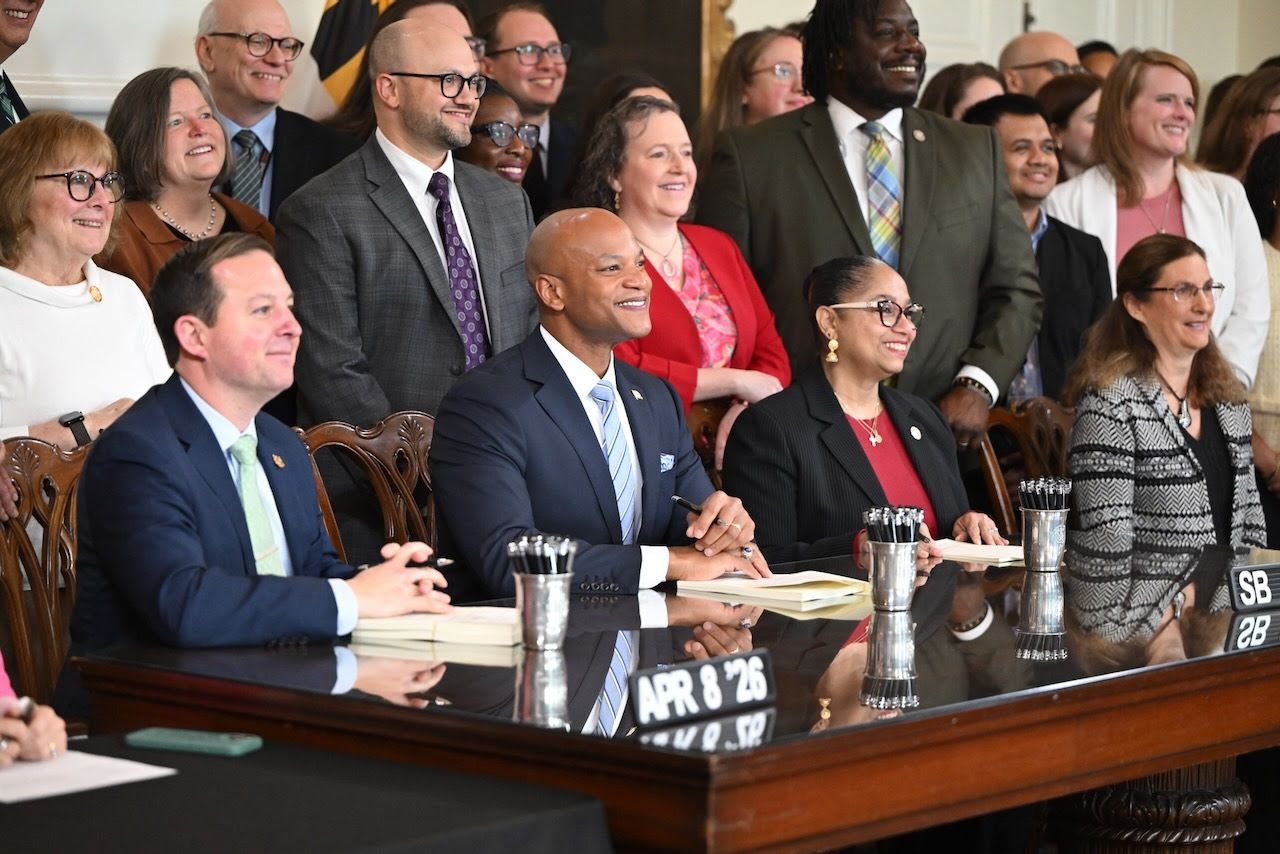
As if on cue, the U.S. Congress reported progress on the National Quantum Initiative Reauthorization Act and the Maryland state government included a significant investment in bolstering that quantum ecosystem.
This, along with lots of funding announcements, adds to the growing realization that quantum is coming.
Thanks for reading — and enjoy your weekend!
— Matt, Chief Content Officer at The Quantum Insider

Congress Moves Quantum Reauthorization Bill to Key Committee Stage
Florida’s First Quantum-Safe Corridor – LambdaRail and the New Shape of the State’s Quantum Push
Quantropi Moves Toward Public Listing Through Mandeville Merger
QDNL Participations Rebrands to Ground State Ventures as Fund Hits $88 Million, Exceeds Target
Quantum Security: Threats, Solutions, and the Race to Protect Data
Cisco Unveils Prototype to Link Quantum Computers Into a Network
New Chip Can Protect Wireless Biomedical Devices From Quantum Attacks
The Noteworthy & Nuanced
A joint team from Cleveland Clinic and IBM demonstrated a hybrid quantum-classical workflow to model the electronic structure of the 303-atom Trp-cage protein using IBM’s Heron r2 processor. The approach combines wave function-based embedding to break the protein into manageable clusters with quantum sampling techniques to solve complex interactions. This quantum-centric supercomputing method overcomes limits of classical simulation and could scale to larger biomolecules, supporting drug discovery and advanced molecular research.
Atom Computing and Cisco have signed an agreement to explore distributed quantum computing by linking neutral-atom quantum systems through quantum networks. The collaboration will integrate Atom’s hardware with Cisco’s networking stack, including compilers and protocols, to tackle challenges such as interconnects, transduction, and distributed workload execution. The effort aims to enable scalable architectures by connecting multiple quantum processors into unified, networked systems.
QpiAI has developed a hardware-based quantum error correction decoder that significantly reduces latency in superconducting systems. Using a union-find algorithm on its 64-qubit Kaveri processor, the platform cuts correction time from tens of microseconds to about 1.5 microseconds. This enables real-time error correction within qubit coherence limits, a key requirement for scalable fault-tolerant quantum computing, and marks progress toward practical, high-performance quantum machines. — Alan Kanapin, Analyst at The Quantum Insider
The Research Rundown
Check out this week’s handpicked quantum research. These are studies headed for real-world impact: improving accuracy, reducing latency, using fewer resources, or solving problems that classical methods struggle with. These are early developments, but they hint at where quantum might earn its keep.
Researchers from Tecnológico de Monterrey and collaborators develop a hybrid quantum–classical machine learning model to forecast hourly black carbon levels in Monterrey, combining classical ensembles with quantum neural networks to capture complex environmental interactions.
Researchers from Aligarh Muslim University introduce QisNet, a quantum-inspired U-Net model for retinal vessel segmentation that encodes image features as qubit-like states to better capture fine, uncertain vascular structures.
Researchers from Macquarie Bank, Accenture, and the SMR Institute of Science and Technology develop a hybrid quantum–classical system that encodes ICU patient data into quantum states to enable earlier detection of sepsis and organ failure, improving classification performance and reducing false alarms. .
— Cierra Choucair, Journalist & Analyst at The Quantum Insider
Want more research insights? Get them delivered straight to your inbox Monday, Wednesday, and Friday with The Daily Qubit. Subscribe below or use the link to update preferences at the end of this email. 👇️

The Global Quantum + AI Challenge is an international initiative designed to move quantum research closer to industrial use. In partnership with enterprises, technology providers, startups, and research teams, the program focuses on real-world problems where quantum computing may eventually create practical value, with AI and high-performance computing serving as key tools for testing, benchmarking, and deployment.
This week’s featured challenge comes from Airbus, which is seeking new approaches to predictive aerodynamic modeling. Accurately forecasting aerodynamic flows requires solving partial differential equations using state-of-the-art HPC, but current methods still face scaling limits and continued reliance on expensive wind tunnel testing under demanding acceleration and Mach conditions. Airbus is looking for more efficient PDE solvers that could help future product solutions meet strict quality, performance, and environmental requirements.
Teams working in quantum algorithms, hybrid quantum-classical workflows, scientific machine learning, computational fluid dynamics, or quantum-inspired optimization are encouraged to take part. Phase I concept proposals are open until 15 September 2026. Sign up now to participate in the Global Quantum + AI Challenge and help turn quantum research into industrial outcomes.
INSIDER SPOTLIGHT: America’s Multi-Layered Quantum Cake is Cooking
➡️ U.S. lawmakers are advancing the National Quantum Initiative Reauthorization Act, signaling continued federal commitment to scaling quantum from research to real-world deployment.
➡️ The proposed legislation places new emphasis on commercialization, workforce development, and supply chain resilience, moving from research leadership to industrial competitiveness.
➡️ At the state level, Maryland is maintaining and expanding quantum investments, including funding tied to IonQ’s headquarters and startup infrastructure despite broader fiscal pressures.
➡️ Florida is moving into deployment with a quantum-safe network corridor built with IonQ and Florida LambdaRail, linking research institutions over existing fiber infrastructure.
➡️ Taken together, federal and state actions suggest quantum is being treated as strategic infrastructure, not discretionary research spending.
Analyst Commentary
Quantum policy in the U.S. is entering a more operational phase — and this week’s developments suggest lawmakers and state governments are beginning to align around that reality.
At the federal level, movement on the National Quantum Initiative Reauthorization Act marks more than a routine legislative update. The original 2018 law established coordination across agencies and helped seed a national research ecosystem. The reauthorization effort is now explicitly focused on what comes next: translating that research base into deployable systems, commercial activity, and industrial capacity.
Lawmakers are signaling that quantum is no longer being treated purely as a science program. The proposed updates emphasize commercialization pathways, workforce pipelines, and supply chain considerations — all indicators of a technology moving into a more strategic, economically relevant phase.
There is also a geopolitical layer to this news. Policymakers are increasingly framing quantum in the context of global competition, particularly with China and the European Union. That framing tends to pull funding and coordination decisions out of the realm of basic research and into national strategy. Once that happens, timelines compress and expectations change.
The U.S. is unique because its public quantum initiatives is emerging in multiple layers, from national to regional to state and even to local.
Maryland, one of the more established quantum hubs, also announced this week that it’s continuing to allocate capital to the sector even as broader budget pressures force tradeoffs elsewhere. The state’s support for new headquarters infrastructure tied to IonQ, along with expanded startup support mechanisms, points to a deliberate effort to anchor a long-term quantum cluster.
This matters because state-level decisions are often the first real test of whether a technology is seen as economically viable. Federal programs can fund research for years without immediate return. State budgets, by contrast, are more directly tied to job creation, tax base expansion, and near-term economic impact. Continued investment under those constraints suggests policymakers see quantum as more than a speculative bet.
Florida offers a different, but complementary, signal.
The state is moving into infrastructure deployment. The quantum-safe corridor being developed through Florida LambdaRail and IonQ is designed to secure communications across existing fiber networks using quantum key distribution — a method that uses the properties of physics to detect interception attempts.
In a subtle but important transition, this reflects a move from preparing for quantum’s future impact — particularly on cybersecurity — to beginning to build systems that address that impact today. The fact that the project leverages existing network infrastructure also points to a practical deployment model, rather than a purely experimental one.
Ultimately, a much bigger picture is starting to emerge.
At the federal level, policy is being updated to push quantum out of the lab and into the economy. At the state level, funding and infrastructure decisions are reinforcing that direction, with different regions emphasizing different parts of the stack — headquarters and startups in Maryland, network infrastructure in Florida.
The convergence is notable. It indicates that quantum is beginning to be treated less like an emerging science and more like a strategic industry with multiple entry points: research, manufacturing, software, and infrastructure.
The next phase will likely depend on execution. Legislative momentum, state funding, and pilot infrastructure projects can establish direction, but the determining factor will be whether these efforts translate into systems that deliver measurable value — in security, computing, or sensing.
Let’s see if this momentum continues — or even picks up.
DATA SPOTLIGHT.

PacketLight Networks and NEC demonstrated quantum key distribution over a 400G dense wavelength division multiplexing (DWDM) network using a dual-fiber setup. They integrated NEC’s QKD system with PacketLight’s PL-4000M 600G Muxponder, achieving 100% data throughput and low latency, verified via a 100GbE tester. The QKD ran over a dedicated parallel fiber, maintaining quantum signal integrity. The result: a cost-effective, scalable quantum-safe model with zero performance tradeoffs on existing high-capacity infrastructure.
INDUSTRY HIGHLIGHTS.
🩺 MIT researchers developed an ultra-efficient microchip that enables post-quantum cryptography on power-constrained wireless biomedical devices, addressing a key security gap as quantum computing advances.
💰 Ground State Ventures, formerly QDNL Participations, raised $88 million for its early-stage quantum fund, exceeding its $70 million target and signaling strong investor demand.
🔬IBM and Massachusetts Institute of Technology launched the MIT-IBM Computing Research Lab, expanding their long-running collaboration to include quantum computing alongside artificial intelligence and algorithms research.
❓A SAS survey of more than 500 global leaders found that uncertainty about real-world applications is now the top barrier to quantum AI adoption, surpassing cost.
⚙️ Florida launched its first quantum-safe corridor through a partnership between IonQ and Florida LambdaRail, marking a shift from planning to deployed infrastructure.
🧬 Qubit Pharmaceuticals and the Centre for Quantum Technologies have launched a two-year collaboration to develop and test quantum algorithms for molecular discovery, aiming to move quantum chemistry methods toward practical drug development applications.
🧑🤝🧑 Mandeville Ventures has signed a definitive agreement to merge with quantum cybersecurity firm Quantropi in a transaction that would take Quantropi public via the TSX Venture Exchange.
🏫 QuantumCore partnered with the Institute for Quantum Computing at the University of Waterloo and joined an NSERC Alliance Quantum grant program worth up to $1.7 million. The collaboration supports development of superconducting TWPA amplifiers, critical for low-noise signal readout in quantum systems.
🏆 The National Quantum Algorithm Center (NQAC) at IQMP announced five Grand Challenges awards, aimed at accelerating practical quantum use cases and strengthening collaboration within the Illinois quantum ecosystem.
🚨 A new study by researchers at Stanford University and Los Alamos National Laboratory warns that quantum technologies face severe supply chain vulnerabilities tied to critical minerals largely controlled by China. The paper identifies niobium and nickel as key chokepoints for superconducting quantum computers.
🤑 Quantum Art extended its Series A financing to $140 million, led by Bedford Ridge Capital with participation from multiple new investors, reflecting strong demand and confidence in its approach to scalable quantum computing.
⛓️💥 A Coinbase-convened panel of six leading cryptographers concludes that a quantum computer powerful enough to break blockchain encryption will eventually be built, and the industry must begin migrating to quantum-resistant security now.
🪙 Project Eleven awarded the Q-Day Prize, a one Bitcoin bounty, to Giancarlo Lelli for breaking a 15-bit elliptic curve key on a publicly accessible quantum computer.
🗾 IQM Quantum Computers will deploy a 20-qubit system to TOYO Corporation, marking the first enterprise quantum computer purchase in Japan. The system will support enterprise and research use cases, with integration into HPC infrastructure and availability via on-premises and cloud access.
EVENTS.
April 27-30 — The Quantum Matter International Conference & Expo (QUANTUMatter2026) will take place at the Barceló Sants Hotel in Barcelona.
April 28 – FullStaQD Community Workshop will take place in Berlin, Germany, focusing on quantum computing software development.
April 28-30 – Quantum Australia Conference 2026 will take place at the Adelaide Convention Centre in Adelaide, Australia, focusing on quantum technologies and their impact on productivity and industry.
May 4-7 – IBM Think 2026 will take place in Boston, Massachusetts, featuring enterprise technology discussions including AI, hybrid cloud, and quantum computing.
May 18-19 –Q-Expo 2026 will take place in Dubai, UAE, bringing together global leaders to explore quantum technologies, AI, and future digital infrastructure.
June 2-3 –Microsoft Build 2026 will take place in San Francisco and online.
June 4-5 -- Q2B Tokyo 2026 will be held exclusively in-person and presented in Japanese and English, with real-time interpretation.
June 10-11 -- The Perspektywy Women in Tech Summit 2026 will feature an expanded focus on quantum technologies through its dedicated Quantum Path.
June 16 -- France Quantum -- the premier event showcasing the French Quantum ecosystem to the world.
June 22-24 -- IQT Nordics: Oslo, Norway
June 25-26 -- Quantum.Tech World -- Empowering Quantum, AI & HPC at Enterprise -- Scale, co-located with Quantum.Tech World will be held at Encore Boston Harbor in Boston, United States.
July 1-3 – The 2026 IEEE International Conference on Quantum Control, Computing, and Learning (IEEE qCCL 2026) will take place from Wednesday to Friday, July 1-3, 2026
September 15 –Quantum Leap Career Nexus 2026 will take place at the University of Maryland.